24 June 2013

A Visit to Hindeloopen

The thin cirrostratus that we had welcomed as a sun blocker on Wednesday afternoon had changed to a solid altostratus by evening. Thursday morning we were under low nimbostratus and rain appeared inevitable by mid-afternoon. Nonetheless, after a luxurious sleep-in and a late breakfast, we unloaded our bicycles from the foredeck and pedalled through Workum and out the other side and using TomTom on my iPad, we chose to follow the bike path on Oude Dijk that runs southwest toward the coast. After nine kilometres we arrived in Hindeloopen.

Hindeloopen was built on three mounds in the saltwater marshes along the Zuiderzee coast of Friesland. It was granted city rights in 1225 and became a member of the Hanseatic League in 1368. In the twelfth century mariners from Hindeloopen had begun voyaging along the North Sea and Baltic Sea coasts fishing and trading. Their strong overseas connections with foreign countries and infrequent contact with the hinterland across the marshes, caused the development of the Hindeloopen language; a mixture of West Frisian, English, Danish, and Norwegian.

We pedalled into the tiny city, pausing frequently to admire the views.

Everything we saw was tidy and well-maintained. There is an evident pride everywhere here.

We pedalled around the church to get the best angle to see its leaning steeple. Though not as impressive as Pisa's leaning tower, it is certainly out of plumb.

We locked our bikes in the convenient racks beside the church...

... and took our panniers up onto the sea dike and down the seaward side to sit on the large blocks of riprap and have lunch. Edi had prepared ham and cheese croissants and we enjoyed them as the sheep and lambs around us grazed on the lush grass.

After lunch we left our bicycles on the racks and went wandering the city and browsing the shops. We bought a few things for Zonder Zorg. I bought a spare Friesian flag for the jackstaff and Edi bought some of the famous Hindeloopen fabrics and some Douwe-Egberts Hindeloopen cup and saucer sets from the artist who designed them. Then it started to rain.

We walked back to our bike rack, which was nestled between the church and the museum. The continuing heavy rain convinced us that this was the prefect time to visit the museum, which is in the building that was the City Hall from 1683 to 1919. The receptionist told us that with all the shipping trade in the seventeenth and eighteenth centuries, the citizens had become quite wealthy and spent a great amount of money in Amsterdam on precious fabrics, furnishings and decorations. They bought many of the goods imported from Asia through the Dutch East India Company. 

The rich town developed its own distinctive costume and a unique style of colourful painted walls and furniture.

The fabrics and clothing designs showed a distinct Asian influence.

As the prosperous times waned, and oak could no longer be afforded, furniture and panelling were made with simpler, less expensive woods. These were ornately painted by the locals to replicate the intricate carving of the oaken pieces. Thus the now famous Hindeloopen decorative style evolved.

Wall panels and doors were elaborately painted.

The museum was full of wonderful examples of early Hindeloopen decorative art.

After nearly two hours of admiring the displays, we were filled to the brim with this wonderful art. We left the museum and scurried fifty metres through the downpour to Restaurant Sudersee, where we had a koffie en chocoladecake to help the rain diminish. The rain persisted, but to help us pass the time, the owner, Piet Bakker offered his wifi code and a link to a weather radar site so we could watch the progress of the storm on my iPad.

After an hour's pause in the restaurant, the radar showed the heavy downpour decreasing to only a downpour, so we took that weather window and pedalled back the shorter six kilometre route to Workum. It was less scenic, but with the heavy, wind-driven rain, we weren't really into looking around that much. Back onboard Zonder Zorg we enjoyed very long, hot showers and were very quickly relaxed and comfortable again. 

23 June 2013

Southward Through Friesland

On Wednesday morning, the 19th of June, with our seven-month refit in Harlingen complete, we went up to the office of Scheepsbouw & Reparatie Friesland to bid our farewells. We had the rare good luck of finding the three partners, Lex Tichelaar, Wychard Raadsveld and Klaas Koolhof in the office at the same time. After we had thanked them for the wonderful work they had orchestrated, I posed for a photo with them. I am not a short person, but with the Dutch having the tallest average height in the world, these three men at 195 to 200 centimetres tall towered over me. Their work seems to tower over that of other yards in our experience.

We flashed-up Zonder Zorg’s new engine, and at 1015 we slipped our lines and headed out. As we motored past the yard, Andre shouted a “Bon Voyage” from his perch on the foremast of his new topsail schooner. We had watched the previous week as the masts were stepped, and now we saw the yards being rigged. There is still considerable interior work to be completed, but she is looking very shippy.

Within ten minutes we were at the Industriebrug waiting for the bridge to be opened for us. We had decided to take the narrow Harlinger Trekvaart, which winds through farmland and small villages to Bolsward. Along the way are several low fixed bridges, the lowest being 2.16 metres and the narrowest 4.5 metres, but before we can get to them, we have five movable bridges that need to be lifted for us. We phoned the number on the bridge sign and were informed it would be about ten minutes; they were just finishing at the other end of the series.

The second bridge was 6.9 metres wide, but required a 90º turn to port from the narrow canal, so it was a good test of my barge-handling skills. I surprised myself with the ease of the manoeuvre, and am delighted that I had fitted the left-hand propeller.

The third bridge, number 7 on the inset from the chart, is a 5.5 metre wide swing bridge with an immediate 80º port turn into the 6.6 metre wide road bridge and the adjacent 6.4 metre wide rail bridge. It was all wonderful barge handling practice.

At 1059 we were through the rail bridge and then very quickly into rural Friesland, with no more movable bridges until the city of Bolsward. There were; however, many fixed bridges, mostly with 2.5 metres of clearance above water. We have not yet accurately measured our air draft since the refit, but preliminary rough measurements that I took show us to be about 2.05 metres. We slid under the lowest of the bridges with room to spare.

Along the canal banks were herds of grazing cattle, needing no fences to keep them in. The canals and drainage ditches serve a dual purpose; enclosure and drinking water.
The canal wound through several tiny villages and settlements and we admired the wonderfully kept homes alongside the canal. Many of these had life-sized livestock sculptures as lawn ornaments, likely representing their owners' livelihood. And everywhere, there were boats moored.

Shortly before noon we approached the village of Kimswerd, which offered a placid, almost surreal appearance as we neared. The day was very hot, with temperatures in the 30s and all morning the sky had been cloudless. We were relieved to have a layer of cirrostratus move in to offer some protection; our bodies are still rather pale from a rather cloudy spring. 

We wound our way around some tight turns in the village...

… and through some tight bridges.

Just beyond the village, we saw a very pleasantly sited wooden wharf, and decided to secure alongside to pause for lunch. The structure is about 60 metres long and it has solid mooring bollards spaced about 4 metres apart. Alongside it runs the old towpath, now a bicycle route. We surmised that because the canal is so narrow and winding through Kimswerd, making moorage there impracticable, the wharf has likely been built to offer passing boats a place to stop to visit the village. 

After a relaxing hour, we slipped our lines and continued along the canal. Shortly past 1500 we arrived in Bolsward and paused briefly as the Jansbrug was lifted for us to pass through. The bridge keeper then pedalled along and prepared the next two bridges for us, and each was ready for us when we arrived.  Within twenty minutes we were through Bolsward and back out into the farmland.

Four more lifting bridges and about eleven kilometres brought us to Workum, where at 1810 we secured alongside on the municipal moorings on the northern edge of the city. We had come 32.7 kilometres in about seven hours of motoring. Unlike our in sailboat Sequitur, there is no autopilot in Zonder Zorg. Steering is a constant hands-on affair with a huge oak tiller, and we were a tad weary.

We decided to stay two or three days to relax and explore the area. The past three weeks or so had been rather hectic with leaving Vancouver, setting-up house in Zonder Zorg, wrapping-up the last bits of the refit and preparing to head south. We need to catch our breath.

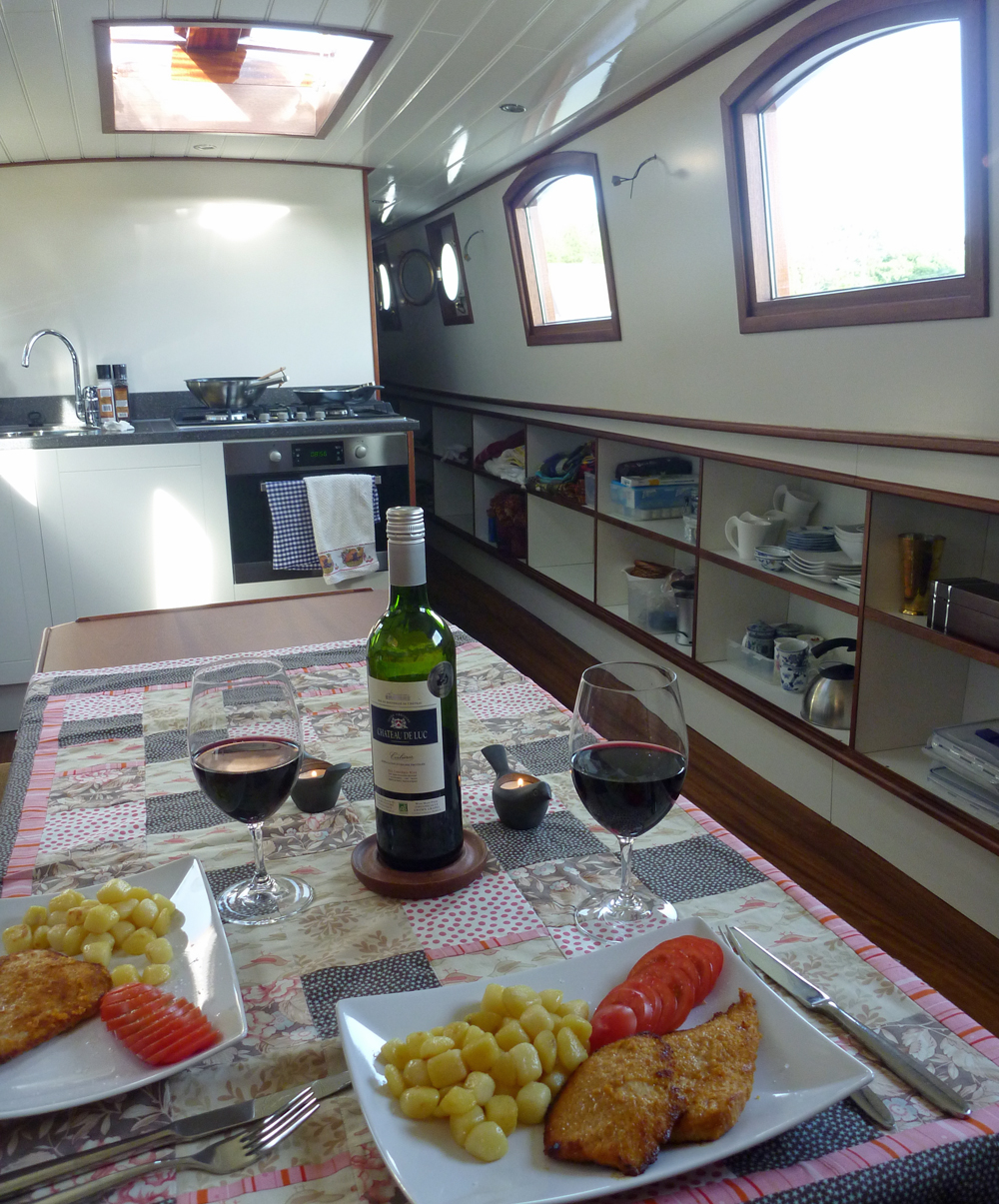
To mark the beginning of our new cruising life, I prepared chicken tarragon and served it with fine green beans almandine and sautéd small potatoes garnished by sliced Roma tomatoes with shredded fresh basil. With dinner we enjoyed a celebratory bottle of Cava Codorniu Classico. I think we will quickly learn to enjoy this style of cruising.

18 June 2013

Final Refit Details

We arrived back in Harlingen midday on Monday after our weekend shake-down cruise. With us we had a short list of arisings that needed attention. While Zonder Zorg is a hundred-and-five years old, that is on the outside only; inside, she is completely new. As with many new installations, there are tweaks and adjustments necessary that are discoverable only with use. We found several. One of these was the hand sink in the heads; in the standard Dutch fashion, it was plumbed for cold water only. The easy fix was to add a mixer to its feed line under the galley sink.

Another item was that a right-hand propeller had been installed instead of the left-hand I had requested. I much prefer a left-hand screw because of the ease of handling alongside starboard-side-to. When the engine is put astern, the stern kicks to starboard, nicely pulling it alongside. When leaving, the forward turning screw pulls the stern to port, moving it nicely away from the wall.

We motored Zonder Zorg around to the travel lift to be hauled and have the propeller exchanged.

The lift was quick and very efficient.

The retaining nut was heated and undone.

The propeller was then heated and then thumped off the tapered shaft end.

The new 22 X 20 LH screw was introduced to the taper, heated and snugged up with the retaining nut, which was then locked in place with a setscrew into a shaft dimple.

While the barge was out of the water, we had a good look at the original registration number stamped into her side in 1908. The S831N signifies that she was the 831st ship registered in Sneek in the Netherlands. Above the number is a line of original rivets joining iron plates in her century-old hull.

While we were out of the water, we had a new through-hull installed just below deck level on the port bow. This is to reroute the water tank breather line, which had been badly routed and had allowed water to overflow into the bilges when we had filled-up the fresh water tanks.

After the very quick and efficient work, we went back into the water and motored around to work wharves on the south side of the site. Shortly after we secured, a Lemmeraak rafted outboard. We counted seventeen boats being worked on in the water and on the hard, and inside the hangars there are another eleven vessels being built or refitted; every space is full. This is an extremely busy yard with over fifty workers and seemingly more work than they can handle, while other yards are idle.

Work immediately resumed, with such things as adding reenforcement webs to the main engine room hatch and installing new sound-deadening insulation.

We also had a locking latch installed, so that we can lock-up the engineering spaces when we leave the boat.

While work progressed, we kept ourselves busy adding interior details. The bedroom is spacious and comfortable, with lots of convenient hanging points. The washing machine and dryer are nicely tucked-away under the foredeck, and we gave them several loads to work with.

On our first trip to Ikea we had picked-up a MemoryFoam pad to put on top of our mattress; the bed is superbly comfortable.

We love the clean simplicity of the interior, and the wonderfully convenient cabinets behind sliding doors all along the starboard side. There is more than enough storage.

The galley is very well laid-out, with everything ergonomically arranged and conveniently placed. We have thoroughly tested the dishwasher. At 45 centimetres width, it is just large enough to swallow in one load everything that we use to prepare and enjoy breakfast, lunch and dinner.

The fridge sits conveniently under the port side-deck and is sufficiently large to store several days of food. Although with shops and supermarkets being very plentiful often within a short walk or cycle from the canals, we don't need to stock-up like we did in Sequitur during our three years sailing around South America.

Of course we have tried-out the new galley repeatedly, and it has consistently produced wonderful meals.

The last few details are being addressed and it appears that we will be ready to head out tomorrow morning. We look forward to many years of zonder zorg cruising in Zonder Zorg.

11 June 2013

Back to Friesland

On Sunday morning the 2nd of June we rolled our ten-piece luggage train the block and a half from our Vancouver loft to the SkyTrain for the ride to the airport. Our flights took us without hitch via Montreal to Brussels and we breezed through Immigration, with Edi’s new Dutch passport allowing us to do the very short EU Passports line; the Other Passports line looked thirty or forty minutes long.

Our car was waiting for us at the Hertz Gold Counter and less than three hours later we were looking across the canal at Zonder Zorg. She looked wonderful in her new colours. Her leeboards had not yet been installed, and we could see work underway with hatches open fore and aft, one of the entry doors standing on the side deck and the carved artwork leaning against a shoreside hangar wall. 

After a quick visit aboard, we went up to the office to announce our arrival to Klaas and to get an update from him on the progress of the work and to find out where our stored bins were. We were shown to a third-floor loft in one of the hangars, where from our pile of belongings we selected two bins in which we could see tableware, stemware, cutlery and cooking utensils and vessels, and we lugged them down to the boat. We then hauled our ten pieces of luggage onboard from the car and drove into town shopping for ingredients for dinner and breakfast. 

Back onboard we unpacked and began organising. The rough sorting was easy with all the sliding doors removed from the fronts of the compartments. There are twenty-two compartments running all the way along the starboard side. With six each in the salon, galley and bedroom and four across from the heads, sorting by place of use was simple. The five drawers and two cupboards beneath the galley countertops easily swallowed everything we threw at them and still seemed almost empty. The bins beneath and behind the settee are huge and they remained nearly empty.

While Edi continued to sort, I prepared dinner. There were no cooking pots in the bins we had brought down from storage, and the hangar was locked for the night. With just a wok and a sauté pan to work with, we skipped the green beans amandine and had a simple meat and potatoes dinner. At 2200 we dragged ourselves to bed, thirty-one hours after we had sprung out of bed in Vancouver.

The next morning we saw Sfinx sitting in the slip around the corner from us. She was one of the three tjalks we had winnowed to our short list from the seventeen we looked at. Looking at her and at Zonder Zorg now, we are delighted with our decision. Looking at the tangle of rigging on Sfinx, we are thankful that we decided not to restore Zonder Zorg to sail; the rig would have been in the way most of the time for the style of boating we want to do now.

Through the following four days, as the yard workers tended to some of the remaining small details aboard, we hauled more things down from the storage loft, We also shopped around in Harlingen for an espresso machine, a bean grinder, a toaster and other comforts of home. On Wednesday and Thursday we made trips to Ikea in Groningen and each time came back with a stuffed car. Thursday afternoon we bought two lightly used bicycles in a shop in downtown Harlingen, and in the evening we tried them out with a grocery shopping trip into town. On Friday we returned the rental car to the Hertz office in Leeuwarden and took the train back to Harlingen.

On Saturday morning we headed out in Zonder Zorg for a shakedown cruise to try out her various systems. We found a very simple and practical way to secure the bicycles aboard, with a fender on the mast tabernacle and a bungee cord. The sluit cover makes a perfect wheel chock.

We headed up the Van Harinxmakanaal toward Leeuwarden under scattered clouds in gusty crosswinds. Among the many boats we saw were a few sailboats on beam or broad reaches along the canal.

Zonder Zorg’s new larger diameter propeller gives her helm a much more stable feel. Previously, the tiller needed to be tended full time, and with considerable effort. Now, the tiller can be let go for short periods and it is much easier to handle.

We motored through Faneker and admired the canal-side homes, many of them with mooring slips where driveways would be in less boat-oriented parts of the world.

We turned off the main canal into a narrow one heading southward. The sign at the canal entrance confirmed the notations on the chart that gave the maximum bridge clearance of 2.4 metres, but with Zonder Zorg's 1.95 metre air draft, we easily passed under.

We wound our way through pastures and tiny villages for a few kilometres, and then turned off the small canal into a tiny one and secured alongside in a tiny wilderness park.

Earlier in the week we had paid €12 for an annual membership in De Marrekrite, a recreation group that provides 3500 free mooring spots at 285 locations throughout Friesland. For the fee we received a burgee which allows us a year of free moorage and map to all the locations. We settled-in and relaxed. It may take us a while to become accustomed to this pace, but we are confident that with practice, we eventually will.