
At 1020 on Monday, 12 May we slipped our lines and continued downstream from Moissac. As we left the Bassin du canal and passed under Pont Tournant, we reflected on our time in the city. Even with juggling through five mooring spots during the eight days, we had thoroughly enjoyed our stop.

Less than a hundred metres along from the end of the basin is Pont de St-Jacques, which has only 1.80 metres clearance under it, about 25 centimetres too low for Zonder Zorg. Fortunately it is a swing bridge and an operator is present from 0900 through 1900, except during lunch from 1230 to 1330 and except for four national holidays. We arrived at the bridge to find a double red light, meaning “out of operation”.

It was not quite 1030, still two hours before lunch, it was not 1 January, 1 May, 11 November nor 25 December. Then we saw legs among the mechanisms under the bridge; it appeared to be under repair or adjustment. We came to the spud pole and a stern line through a ring on the wall.

For nearly half an hour we watched as men went up and down the steps, in and out of the control cabin and back and forth across the bridge to a truck full of tools and equipment.

Finally, the double red changed to red, then to red and green and the bridge began opening with several sets of eyes intently watching the workings below. The light went green and we slid through the gap. As we passed the rotated bridge deck we could see it was a relatively new structure, having been built in 1955 by De Fives-Lille.

We continued along the canal for another 17.5 kilometres, passing through six more locks and at 1343 we secured to a free mooring on a wooden wharf on the left bank. We were just upstream of a bridge leading across the canal and into the town of Valence d’Agen. Across from us was the town’s halte nautique with fees for mooring.

After lunch we walked the two hundred metres to the edge of town. At the base of the hill on which the town was built is a wash house, which uses the water from a spring on the slope. Built at the end of the eighteenth century, it is one of two in the area with this graceful circular design.

We arrived in the centre of town to find it deserted. It was past mid-afternoon and all the shops were closed, but then we remembered it was Monday.

We continued through the wonderful old streets, which interlink four squares. La pharmacie de garde was open, as was an obligatory boulangerie. Following a zigzag route through the town centre, we came to the supermarket I had identified from the appearance of the parking lot on Google maps on my iPhone. I had given up using the search feature; the closest supermarché or supermarket or Carrefour or Géant Casino or Intermarché was generally the other side of France or in another country. It appears most French businesses have not bothered to enter their locations on the Internet maps.The Casino supermarket was open… on a Monday. Its posted hours show it remains open through lunch and is open on Sunday morning. There is some progress in France.

On Tuesday morning we walked back into the centre of town and saw a dramatic change. The four squares and all the streets interconnecting them were crammed with market stalls. There was a bustling crowd and a lively business being conducted.

Of all the markets we have seen in the past year in France, this was the largest and most active. It reminded me of those in Chalon-sur-Saône and Chagny a decade and a half ago, spilling through the entire town centre.

As we were leaving, the lunch crowd was just beginning to gather at the several stalls that were dishing-up from huge cauldrons of cassolet, paella, moules and so on. We passed on the prepared foods and filled our cart with fresh produce, a good portion of it appearing to be directly from the producer.

On Wednesday we offloaded the bicycles and pedaled across a branch canal that supplies cooling water to the nuclear power plant downstream. We followed the road for five kilometres past some fine homes and two châteaux, one of them offering guest accommodation.

We crossed the bridge over la Garonne and came to a hill leading steeply up to the village of Auvillar.

We had come because the guides reported the village as one of the most picturesque in France and having among other attractions a museum devoted to barging on la Garonne. It was noon as we arrived at tour de l’horloge in the centre of the village and the place appeared abandoned.

We could find no bicycle racks, so we locked our bikes to a construction barricade under an arch of the galleries that surround the market square. In the centre of the square is a circular grain market, which was built in the early nineteenth century and is noteworthy because it has both the new metric measurements and the old medieval ones.

The streets were abandoned as we did a walking circuit along the narrow, winding lanes of the village. We saw a crêperie, a café, a bar, and a restaurant, but their menus and cartes didn’t tempt us to part with €30 or more for lunch.

We continued our meander through the village, pausing to visit église St-Pierre, one of the historic stops on the pilgrimage to Santiago de Compostela.

Somewhat past 1300 we again passed the small epicerie/tabac across from tour de l’horloge and saw it had reopened after lunch. Inside we had a quarter kilo piece sliced off a fresh brie, added a baguette and a 125 centilitre bottle of sparkling water and paid a total of €2.98. We walked along to a stone wall and enjoyed a delicious lunch for two. The village looks down on la Garonne and for centuries it was an important river port for the 3000 boats per year that went past.

We finished our delicious lunch and headed across to le tour de l’horloge to visit le musée de la batellerie, the boating museum, which was just opening as we arrived at 1430. Inside we found a scattering of photocopied sheets taped to the walls of the clock tower. We went up to the next level and found the same, plus a model of a river barge. The next level up continued the theme, but rather than a boat model, there was a small telescope and a display of astronomy pictures. The top level was empty. To quench our thirst for river boating history, mounted on a pillar in the central square is an old anchor. The placard beside it tells that it was forged in Bordeaux in 1630. It was found complete with its chain in the gravel banks of the port below the village in 1950. One can only imagine the fate of the boat that had been attached to it.

At 1046 on Thursday, 15 May we slipped from our mooring in Valence d’Agen and continued down the canal. A short distance along we passed a public abattoir very prettily dressed-up in the morning sun.

Four kilometres along we were passing the cooling towers of the local nuclear power plants. We had recently been remarking how France and the USA depend so much on nuclear and fossil fuels for electrical power, while Germany, with less sun produces more than a dozen times as much solar energy as the USA and many fold the solar output of France.

As we left our second lock of the day we met Zelden Rust, a small Dutch flagged sailing tjalk, which had been below the lock waiting for us to descend. Edi greeted them in Dutch as we slowly passed.

At 1429 we secured with spud pole and a pounded pin on a dilapidated wooden wall in l’Hermitage, a basin on the north side of central Agen. The basin is large, but very unwelcoming, with no facilities for passing boaters. In a nook across the basin is a rental boat base and the remainder of that side is directly on busy road beside the main railway line. After lunch I walked along the basin and the continuation of the canal to see if Agen was more welcoming further along. They are not.

Further along, the road traffic turns away from the canal, but the bank is inaccessible from the towpath, making mooring in this quieter area impractical. A kilometre and a half along is the entrance to le Pont-canal d’Agen, the aqueduct over la Garonne. There is a small basin with mooring bollards immediately before the signal lights and the activating wand. Moored in the spot was Bees Knees, a British flagged rietaak and I saw room in front of it for Zonder Zorg. I walked back and we motored along to the spot.

There are only the two bollards in the spot, so we moved in ahead of Bees Knees, dropped the spud pole and secured the stern with a line. The spud pole landed on the sloping paved bottom of the canal leading to the aqueduct and our bow slowly drifted out. After a few more tries, we finally accepted the invitation from Deirdre and Michael to raft alongside Bees Knees. They are a Canadian couple from Toronto, who after a few years on the canals had sold their 1912 Dutch barge and were giving-up possession in two days. As we had arrived, they told us that the bridge and the set of four locks the other end of it were closed. The traffic lights were out, they had received no response from the dangling wand and they had heard there was a strike.

We were not yet ready to move on; we wanted to visit Agen, which despite its unwelcome face to visiting boaters is apparently a lovely city. We had a strong signal on our iPhones, and digging around on the internet we found that the canal bridge and lock closure was part of rotating strike by government employees protesting the new move by the Prime Minister to try to scrape the French economy off the basement floor. He had proposed a freeze in civil servant wage hikes for three years. We further learned the strike affecting us was for one day only. With no water available to passing boats in Agen and not wanting to get stuck here if the labour action escalates, we decided to move on in the morning to the free water and electricity supplied by the village of Sérignac ten kilometres down canal. There we could wait out a prolonged strike.

In the morning a fifteen metre tjalk, De Jonge Douwe, built in 1896 rafted outboard us. The two French men aboard had just taken possession of it two days previously and they were still trying to sort-out how it handles. We were now three old Dutch barges waiting for the traffic lights to be turned on for the day. As 0900 approached, we loosened our lines on Bees Knees and we motored forward about three metres carrying De Jonge Douwe with us until Edi could reach the dangling wand. The red light came on at 0900 and a second later Edi twisted the wand and the lights went red-green. Our end of the system had won the right to go first. Because of the length of the locks, we couldn’t fit in with Bees Knees, so we let De Jonge Douwe go with them when the light turned green.

As soon as the light went back to red, Edi twisted the wand and a little over twenty minutes later we got a green allowing us to head across le Pont-canal d’Agen. The aqueduct is five-hundred-eighty metres long, supported on twenty-three arches each of twenty metres span. Its first stone was laid in 1839 and it was completed in 1843. At its downstream end are four locks within a kilometre that take the canal down about 12.4 metres to the level of the banks of la Garonne. The aqueduct and four locks act as an automatic set, each one triggering the next.

In the first of the locks we saw pipe bollards, which would make our descent easy. Unfortunately, the one at the downstream end of the chamber was missing its pipe and was therefore useless. Complicating this is the safety railing placed in such a way to make the lock more difficult and hazardous for boaters. It appears to be another design by a civil engineer with no knowledge of boating nor any concern for the needs of boaters.

We made it down the four locks and continued down a narrow, overgrown section of canal with many fallen trees well out into the channel.

At 1128 we secured to large cleats on a solid quai in Sérignac-sur-Garonne. We plugged into the free shore power and filled our water tanks. With a butcher, a baker and a small épicerie in the village, were ready for a prolonged strike if it happened.

The history of Sérignac goes back to a Roman centurion named Serenus who gave the village its name in the first century. The locality was fought over through the middle ages and in 1273 it was fortified as a bastide and became part of the royal domaine of France during the reign of Henry IV. Several medieval houses remain in the village centre.
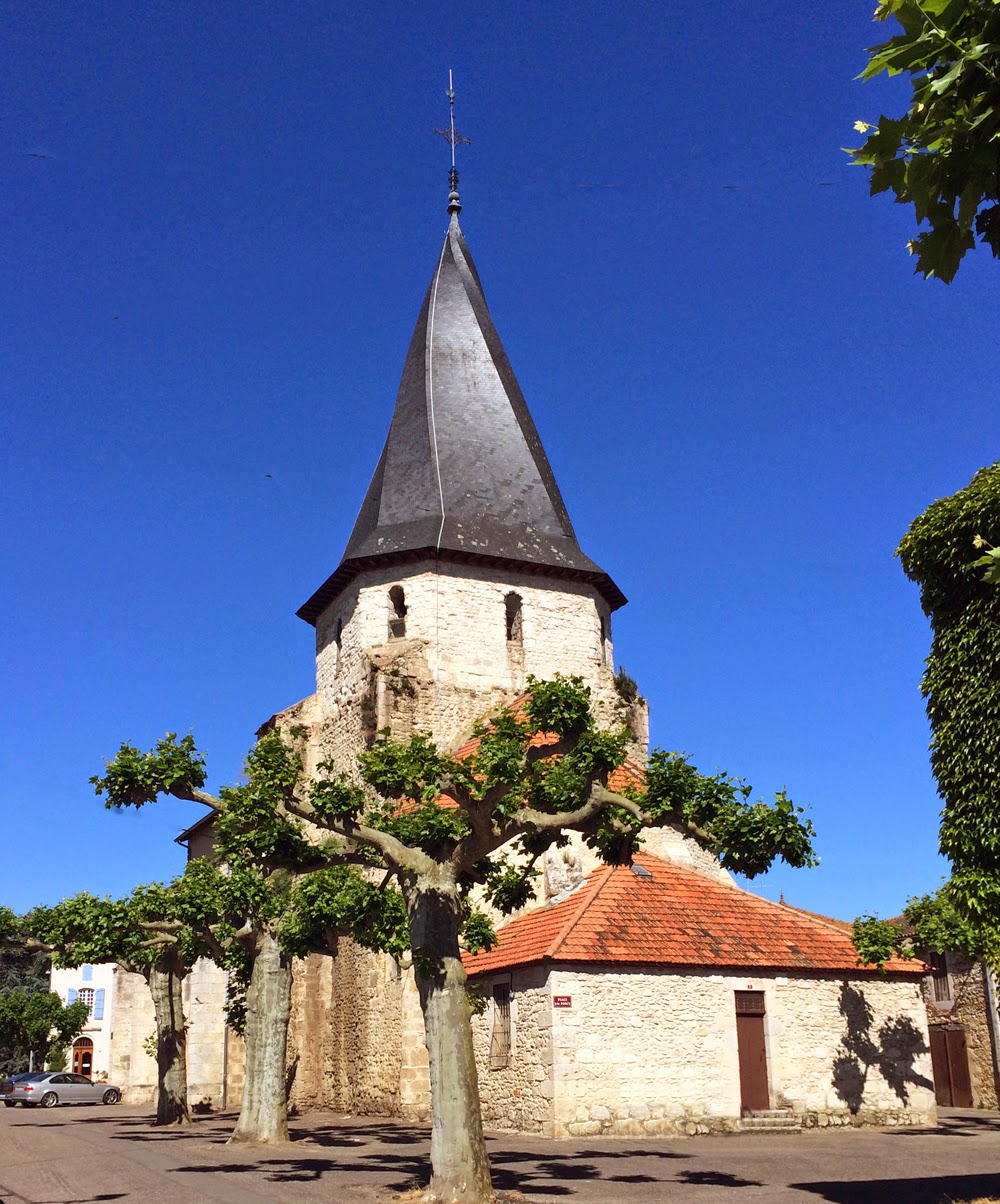
Much of the existing church was built from 1580 to 1600, but significant parts of it date back to the eleventh century. It was once remarkable for its helicoidal tower, which unfortunately was destroyed in a storm in 1921. Finally, after enduring the plain replacement tower for long enough, the citizens came together and in 1989 installed a new version of the old twist.

In the afternoon we bade farewell to Deirdre and Michael as they left on their final day of cruising, familiarizing the new owners with the workings of Bees Knees.

The following day, Friday with our water tanks full and batteries at 100%, we decided to continue along the 17 kilometres to Buzet-sur-Baïse, where if needed we could go to the marina for water. The canal remained narrow with overgrown banks. The only clearing we saw was from the scattering of crude fishing shelters.

At the first lock there was a French-flagged Dutch aak waiting for it to prepare. We followed the aak into the chamber and rode down with it.

After thirteen kilometres we crossed le Pont-canal sur Baïse, the aqueduct over the Baïse River.

The towpath across the bridge has an attractive inlaid tile pattern. Out of the aqueduct is a pair of linked locks that take the canal down five metres to run parallel to and about three metres above la Baïse.

As we approached Buzet-sur-Baïse, we watched as a rental boat collided with the aak in front of us. We were less than two kilometres from the rental base and there is serious risk that the drivers of any approaching rental boats will have fewer than two kilometres of boating experience.

The bangy boat continued zigzagging along toward us, apparently oblivious of having caused the aak to end up in the bushes on the overgrown bank. By the time the rental weaved its way past us, we were stopped. They seemed unconcerned.

Soon we came to the short branch leading to the double lock, which takes traffic down to la Baïse and back up.

Two hundred metres further along, just upstream of the bridge leading into the centre of Buzet-sur-Baïse, we secured with the stern held on a rocky bank with a pounded pin and the bow held by the spud pole. We were at the point of departure for heading up two navigable tributaries of la Garonne: la Baïse and le Lot and we paused to await lock schedules and navigation conditions.


