On Sunday the 4th of February Edi and I flew via Montreal to Brussels, where on Monday morning we picked-up our rental car and drove northward to Harlingen. Shortly before noon we arrived at SRF and were taken to the hangar to see Zonder Zorg.
Work appeared to be progressing well on raising and lengthening her roef; most of the steelwork and welding had been completed and the grinding had been commenced. We were very pleased with what we saw. With the additional 11 centimetres in height and the extra 1.15 metres of length, the interior space seemed so much larger.
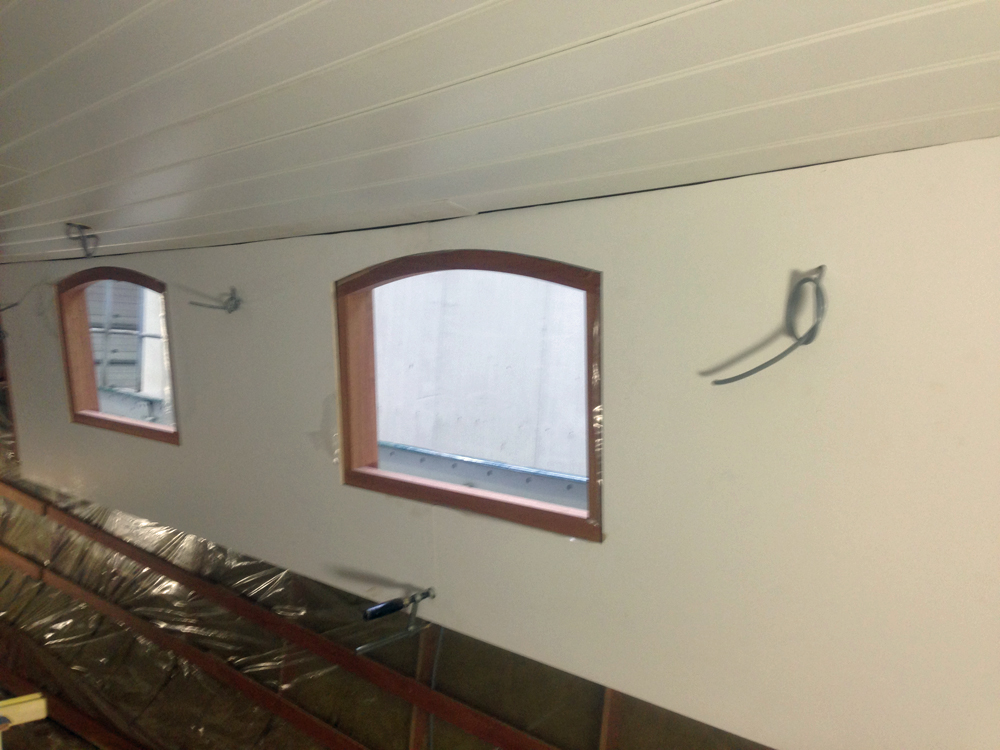
Of course, with the interior stripped-out, the space was even larger.
We were delighted with the condition of the 105-year-old riveted iron. It looks as good as new, and if an observer didn't know it was over a century old, it could be easily mistaken for rather recent construction.
After spending Monday evening getting over our jet-lag, we spent much of Tuesday and Wednesday measuring, sketching and planning interior layout details, and in meetings with Klaas and Wychard discussing mechanical, electrical and plumbing systems, cabinetry, appliances and interior materials and finishes. Among the many things we decided were the countertop style and colour, the wood for the interior flooring, the exterior paint scheme, the redesigned of the salon windows, and the portlight styles, numbers and placements. We discussed plans for an anchor winch, a spud leg, engineering spaces layout and many other details.

On Thursday morning we brushed the snow off the car, scraped the ice off the windshield and headed south, leaving the yard to continue with the refit as we went in search of a warmer climate. We stopped for the night in Meaux, France, where along with other things, we enjoyed Brie de Meaux with our dinner. On Friday we drove through Paris and Tours to Cognac, where we filled up with foie gras and Cognac. On Saturday we drove the back roads through St Emilion and Bordeaux and continued southward through Biarritz to San Sebastien, Spain to find a hotel for the night. The city was overrun with Carnival celebrations, so we endured the heavy traffic jam just long enough to escape the madness and head up over the snowy pass and down into a much more peaceful Pamplona and a hotel for the night.

On Sunday we drove the back country to Borja and then up the hill to the fifteenth century Santuraio de Miseriacorda. We had come to see the latest in the world of art restoration and to admire the work of Cecilia Giménez, currently the most famous art restorer in the world. Her amazing August 2012 restoration of Ecce Homo, a fresco in the chapel is on display secured behind bullet-proof glass.
For comparison, here is a file photo of the fresco before her restoration work.
The convent now charges an admission fee to see the restoration, and they have a map with pins to indicate the origins of the growing number who make the pilgrimage to admire the work of Señora Giménez. We were the first recorded visitors from Canada.
Preferring to take the roads less travelled, we told the TomTom program in our iPad to avoid the autoroutes on our way from Borja to Valencia.
With no schedule and no itinerary, we followed some extremely curvy roads through spectacularly wild and very sparsely populated country.
In the province of Castellón we spotted a wonderful hilltop town. We drove up the hill, through the gates and pulled into what appeared to be the only vacant parking spot in Morella. It was directly across from Hotel El Cid, so we decided to spend the night. The town traces its past from Stone Age cave paintings and Bronze Age graves. More modern history includes the Greeks, who established a treasury here. Later it was the scene of conflict between the Carthaginians and the Roman Empire during the Punic Wars. The town was Romanized and then in 714 the Moors captured it. The castle, which overlooks the town from the top of the rock, is reputed to have rebuilt by El Cid, and in 1084 he is said to have defeated Sancho Ramírez of Aragon at the Battle of Morella. Then there is the recent history from the twelfth century onward.
Among much else here, we were fascinated with the wonderful thirteenth century arched aqueduct. We were enthralled with the town, its history and its surroundings.
On Tuesday morning we continued on the back roads to Valencia, which we found too bustling and hectic, so we continued south along the coast looking for a place that spoke to us. After a couple of hours of winding on coastal plains and through coastal hills, we came around a corner and saw the Peñón de Ifach below us.
We drove down into the town of Calpe and found ourselves following signs to Hotel Sol y Mar; the idea of Sun and Sea spoke to us. We were sufficiently impressed with the hotel to check-in for four nights. Our seventh floor balcony looked out onto the Mediterranean and to our left we could see along the town's beachfront to Peñón de Ifach, the ancient lookout. The temperature was in the upper teens and the sun on our large balcony was almost too hot.
Wednesday morning we walked eastward along the Calpe beaches to Peñón de Ifach and in the afternoon we sunbathed on our balcony. Thursday we walked westward and found a trail that wound up and along the cliff tops.
We paused to admire the views, smell the flowers and bask in the upper-teens temperatures, then we went back to the hotel to sunbathe on the balcony.
It appears that the ancients must have used room 721 of Grand Hotel Sol y Mar in Calpe to determine Valentine's Day. The sun rises directly over Peñón de Ifach. Here's the view from our balcony at 0820; the temperature was just starting to rise from the 12º overnight low and it looked like another warm sunny day.
After four wonderful days on the Costa Blanca, we drove the back roads to Andora, where Edi crossed-off her 85th country and I did my 76th. The place was way too buzzy with hectic weekend skiers joining the already-crazed longer-term ski crowds. We opted to continue up over the pass and down into France to find some quiet and calm. We stopped in Foix for the night in a charming old riverside hotel and then continued the next day to Carcassonne and Narbonne to look for winter moorings for Zonder Zorg for the end of the coming cruising season.
From Narbonne we continued southward along the Mediterranean Coast to Prepignan and Banyuls, enjoying two days of pleasant weather, splendid scenery and marvellous food and wine. On Monday we drove to Orange and spent some time exploring the first century Roman theatre.
It is the only remaining Roman theatre wall in Europe and for the past century and a half the theatre has been used for regular dramatic and operatic performances.

Tuesday we drove to Gigondas for a tasting appointment with Louis Bernard. We were received by Sylvain Jean, the head winemaker and Jasper Van Berkel, the cellar master. They presented us with a splendid range of Rhône wines, three whites and five reds. While the whites were all very pleasant, we were most impressed by the reds. A big bargain is the 2011 Côtes du Rhône Villages. With its concentrated cassis, plum and dark cherry flavours and its long complex finish, it drinks well beyond its price. The Gigondas offers a nicely balanced mouthful of dense jammy fruit and spices leading to a long finish with pleasant tannins. Both the Châteauneuf-du-Papes were splendid examples. We particularly liked the 2010 Domaine la Crau des Papes. It has a complex spice and cooked fruit nose and shows a wonderfully supple fruit palate with well-rounded tannins and cedar and spices on its long finish. It is a delicious 90 point wine.
After the tasting we drove northward to Beaune, where we spent Tuesday night in Hôtel Henri II. This four-star hotel is a lovely renovation of an old residence and adjacent buildings dating to 1626. It is located just outside the north gate of the city, within easy walking of the medieval centre of town. On many occasions during the 1980s and 90s I had used it as accommodation for the participants in my small-group wine and food tours. It was fun to see it again.
On Wednesday morning we were received by Lisa Brown and taken on a wonderful tour of Jaffelin's thirteenth-century cellars in the Clos du Chapitre. I had visited these cellars several times over the past two decades and had enjoyed some splendid catered dinners among the wine barrels with my wine tour clients.
It was Edi's first visit here, so Lisa gave a very thorough tour of the cellars and then the winemaking facilities above.
After the tour we had a marvellous tasting of nine white and red burgundies and a Crémant. All the wines were impressive, but the 2009 Beaune 1er Cru Sur les Grevès Clos Sainte Anne Monopole was the most impressive of the lot. It is a hugely complex and deliciously long wine that reenforced again my decades-old passion for great Burgundies.
We paused in a small restaurant in the heart of Beaune for a lunch of jambon persillé and boeuf bourguignon to help ameliorate the wine we had absorbed during the tasting. Although the rule during tastings is to spit, there is always some absorption of alcohol through the skin in the mouth. Compounding this is that with great wines, the direction of spitting is often toward back of the mouth, rather than the front; down the gullet, rather than out into the sink or crachoir. There had been too many great wines in this tasting. With the alcohol suitably dissipated over the slow lunch, we drove northward to Reims, where we found a very comfortable room in Hôtel Port Mars.
On Thursday morning we explored around Notre Dame de Reims looking for the best sun angles on our way to a visit, tour and tasting with Champagne Roederer.

We enjoyed a wonderful two hour private tour conducted by the very charming Mme Eve-Claire Mathieu-Risbourg, followed by a splendid tasting. Although I had previously heard a few times the story of the origin of the Roederer Cristal bottle, it still fascinates me: Alexander II of Russia had named Louis Roederer as the official wine supplier to the Imperial Court of Russia. The political situation in Russia at the time of Alexander's rule was unstable and he feared assassination, so for his Three Emperors Dinner in 1876, he ordered that the Champagne bottles be made clear, rather than the usual dark green, so that he could see the bubbles and that the bottle have no punt in its bottom, to prevent hiding a bomb in or under the bottles. Louis Roederer commissioned a Flemish glassmaker to create a clear lead cristal Champagne bottle with a thick, flat bottom. The wine became known as "Cristal", and it is considered as the first prestige cuvée. Until the Russian Revolution, it was sold exclusively to the Imperial Court. It became available to the open market only in 1945. Today, while the shape and colour of the bottle remains the same as in the Tzar's days, it is now made of a safer non-leaded glass.

In the afternoon we drove northward into and through Belgium and on to Edam, Noord Holland, where we took a room in Hotel de Fortuna, a charming little hotel next along the canal from Edi's great-grandfather's bridge, the Kwakelbrug.
Our room was in one of the small houses along the canal in the gardens of the main building. From its rear we overlooked the Kwakelbrug.
Next to the Kwakelbrug is the the last remaining shipyard in Edam, Scheepswerf Groot, dating back to 1768. On the verge of the shipyard is the house in which Edi's grandfather was born and grew up. His mother was Grietje Groot, from the family of the shipyard owner.
Our room was very comfortable and beautifully appointed.
After an excellent included breakfast in the hotel restaurant, Edi and I drove northward to Harlingen to see what work had been accomplished in the two weeks since we had headed south. The first thing we saw was that the salon windows had been removed and the holes enlarged and reshaped.
Also, the three various sized and styled portlights on each side of the forward part of the roef had been removed, their holes filled and two larger new portlights let in on each side of the house. The steelwork on the house had been completed and ground. We were very pleased.
In the bottom of the engine room, a portion of the hull had been cut away and a well constructed to accommodate the new engine and transmission. Even though the new engine is smaller than the old, because of the lengthening of the house by 1.15 metres, we are moving the engine mounts aft by that amount. This necessitated the construction of a bubble beneath the existing hull so that a proper shaft angle could be maintained.
On the exterior, there will be a slight widening of the keel leading to the stern bearing and the rudder skeg. To compensate for the small disruption in water flow around the fatter keel, a larger 22 x 20 propeller has been ordered.
On the interior, the scheepstimmerman had commenced laying the subfloor and he told us he would shortly begin stringing battens for the interior sheathing.
On the foredeck, the two lockers for the gas bottles had been constructed, one on either side of the mast tabernacle.
Also on the foredeck, pads had been welded in place to take the new anchor winch. The winch, which is a new-built replica of an antique design, is meant to take a wire rope around its spool. The winch is hand operated and has a free-fall feature, which allows quick deployment in an emergency.
We next went to the carpentry shop to look at the new window frames. The timmerman was just glueing the last pieces on the sixth and final frame when we arrived.
The other frames were standing by on either side of his workbench, waiting for their double-glazed inserts. We were very pleased with the progress, and with the quality of the work done. We met with Klaas and decided on a few more details. With most of the design decisions made, we felt easy leaving Zonder Zorg in the hands of SRF and heading back to Vancouver.
Mid-afternoon on Friday we drove back to our hotel in Edam by way of a stop in Grou to visit the upholstery shop that will be doing our salon furniture. We looked at many dozens of fabric swatches and quickly picked our preferred fabric.
After breakfast and checking-out on Saturday morning, we drove around to take one last look at Edi's grandfather's house. The parking spot closest to the house was empty, the only one we could see in the whole area. This meant we had to stop. We walked down the narrow lane to shoot photos of the house, and as we were shooting, a woman pushing a bicycle came across the Kwakelbrug and paused.
As we walked back toward the car, we looked back and saw her unlock the door of the house and begin manoeuvring her bicycle in. We went back and introduced ourselves and she invited us in. We had been in the house in September to see it being restored and renovated. It was still in disarray with finishing work yet incomplete. Betty introduced herself as the wife of the shipyard owner. Her husband had been born in the house and last year when he was diagnosed with cancer, he decided he wanted to move back in to finish his life here. He died in October before the work on the house was completed.

Outstanding among the nautical clutter we saw was a half-model of a ship, and I asked about it. Betty told us it had been designed by the yard, built, disassembled into pieces, shipped to Peru and taken up to a lake high in the mountains. Edi and I immediately thought of the steamboats on Lake Titicaca, on the border between Peru and Bolivia. These had been hauled the nearly 4000 metres up from the coast and reassembled in the late nineteenth and early twentieth centuries.
Edi told Betty of having taken photos of some of them while she was there in 1979, and in her computer she found a digitised version of a transparency that she had shot back then. Both Edi and I were aware of British-built boats on Titicaca, but not of Dutch; we will have to dig deeper.
From Edam we drove out to Wijk an Zee and paused in front of the house in which Edi had been born, then we continued up into the coastal dunes to look out over the North Sea. From there we continued southward to Haarlem to look at the fine old buildings and to visit Edi's cousin, El, who had invited us for lunch.
After a very pleasant couple of hours enjoying an Italian-Dutch lunch, we continued southward to look for a place to stay within an easy drive of the airport in Brussels. It was threatening to snow, and we wanted an easy drive on Sunday morning for our 1030 flight back to Canada. Just past Antwerp we left the highway to head into Mechelen to find some accommodation. We drove for many kilometres through very bland city and its urban sprawl and saw no hotels, inns or any other form of lodging. As we continued through mundane linear communities, we became increasingly convinced that people mustn't stop in Belgium; we could find no public accommodation. Finally, after more than an hour of urban and suburban traffic, we found an Ibis Hotel in the centre of Leuven, about 20 kilometres from the airport.
Sunday morning as we swept the snow off the car, we were pleased that we had stayed so close to the airport. As it was, it took us nearly an hour to drive the short distance. The flight was nearly an hour late departing because of weather, so we missed our connection in Montreal and had to wait over four hours for the next flight to Vancouver, which was also weather-delayed. Finally, at just past 2300 we arrived home after more than 24 hours in transit. We were travel weary, but very upbeat from our wonderful three weeks of adventures in Europe. We couldn't believe we had been gone only three weeks; the time had been so stuffed with such a diversity of places, people and experiences that it seemed more like three months.