08 August 2013

To Maastricht

Our museum passes had given us free access to Abdijkerk in Thorn, and we emerged after more than an hour totally entranced. We walked along Wijngaard to the Gemeentemuseum Het Land Van Thorn, the community museum. Again, our museum passes gave us access. Among the displays, the most fascinating for us was the very large and wonderfully detailed scale model of the village of Thorn as it was when the seven-year modeling project was completed in 1985. 

From the museum we pedalled along to the Spar supermarket, where we picked-up a few items to replenish our fridge, breadbox, wine cellar and pantry. After two months aboard on the European canals, we have finally become accustomed to not having to stock-up for weeks or months at a time as we had done for three years on our sailing adventure around South America.


Back onboard Zonder Zorg we relaxed for the remainder of the day, and then at 0930 on Thursday the 1st of August we slipped and motored along the kilometre or so to the bunker barge to take-on some diesel.

I had been discussing the price of diesel fuel on the DBA Forum for the past few days, and the consensus was that the bunker barge at Wessen had one of the best prices in the Netherlands. It was at €1.495 when we stopped, which is only 0.04 more than the road station from which I had hauled jugs in Veghel.

We took on 160.55 litres, and to continue calibrating the gauge, I took photos before and after adding fuel. The level at the beginning was about a tenth of the way between the two chalked marks: 50 and 150. After adding 160.55 litres, it was showing about six tenths of the way to the 150 mark. I now have some more clues on the calibration of the gauge, and will need to do some calculations to fine-tune it.

As we were fueling, a line-up of waiting boats began to build, and as soon as we slipped, the mooring spot at the pump was quickly filled. 

As we headed up the arm to its junction with the Maas, we watched as more boats joined the waiting line. This is the only marine fueling facility we have seen in the Netherlands with a line-up. Its price is 10 to 15 cents cheaper than the others we have seen thus far, and it is good to see that the business is being rewarded. I would wager that its low markup, high volume formula easily makes it a more successful business than the high markup places we had seen with few or no customers.

As we made our way back out into the Maas and along it, Edi brought up a platter of open-face sandwiches, which we enjoyed as we passed through rather bland industrial areas.

With little scenery of interest, Edi went below and began painting the Zonder Zorg name board that she had finished carving.

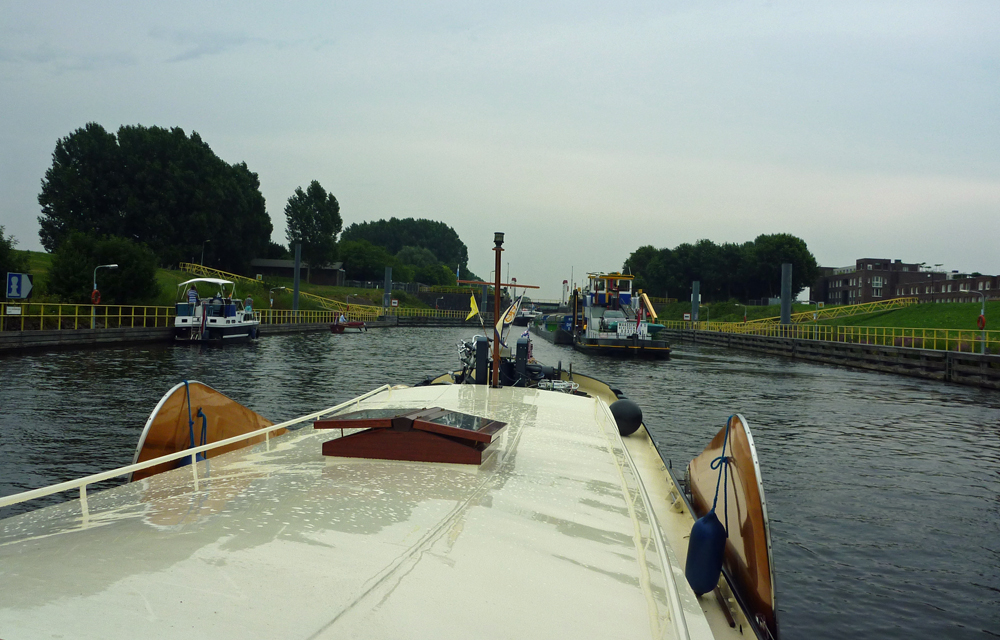
Shortly we came to the first lock of the day. This was one of the two smaller ones in a triple set, but it was still huge to us. We were pleased to see as we entered, that there are floating bollards in the walls.

With the floating bollards, we simply secured Zonder Zorg between a pair of them and monitored the system to ensure that it didn't stick or jam. As the water rose, the bollard floated up, maintaining the barge nicely alongside the wall. 

This was much simpler than the last several locks we had been through, where we had to keep moving the lines up the walls to successively higher bollards.

A dozen or so kilometres further along we came to the second lock, another set of three side-by-side chambers. The lights were red for all three of them, so we paused to see which one would cycle for us. Shortly, the Oude Sluis gate opened and a parade of boats came out, and when they had cleared the chamber, we were given a green light. 

There is a caution sign at the entrance to the chamber mentioning turbulence toward the head of the lock. We secured to a pair of floating bollards about two-thirds of the way along the chamber, leaving room behind us for later arrivals. When the chamber began flooding, we experienced the largest and most violent churning I have ever seen in my many hundreds of locks during eight years of European canal boating. The floating bollards, and Zonder Zorg's shallow draft and flat bottom allowed us to comfortably ride the roiling water.

At 1630 we secured alongside a float in Pietersplas, a peaceful marina three kilometres south of Maastricht and three kilometres from the Belgique border.  

We enjoyed a wonderfully relaxing evening, with dinner in the cockpit and itinerant swans dropping by looking for orts.

Our after-dinner Cognac rendered the late twilight a tad blurry, even for the camera.

07 August 2013

Thorn - The Smallest Principality

On Thursday the 1st of August we had secured Zonder Zorg in the marina in Wessum, across the Maas from the more industrial town of Maasbracht. In reply to our query about the most convenient supermarket, the havenmeester told us there was none worth looking at in Wessum, but that there was a good Spar in Thorn, a village about three kilometres away, next to the Belgique border. We pedalled over.


A few days earlier, Edi had mentioned Thorn to me, calling it The White Village. I had looked it up on the internet and was fascinated with what I found. First mentions of the area were as a marshy region near the Roman Road between Maastricht and Nijmegen. The marshes were later drained and around 975 Thorn Abbey, a Benedictine convent was built there by Count Ansfried and his wife Hilsondis. In 995, after the death of his wife, the count became the Bishop of Utrecht.


During the twelfth century, the abbey evolved from a religious to a secular order; it became a convent community for women without the strict laws of a religious order. At its peak twenty ladies of noble birth lived there as canons. Admission required the women to prove that they had sixteen ancestors of noble birth, eight on each their father’s and their mother’s side. The canons met in the Chapter Room under the leadership of the Abbess. Today on the walls of this room are hung portraits and pedigree documents of some of the twenty-nine Abbesses who led the community from 982 to 1795.


By the twelfth century, the abbey had developed into a complex of buildings covering an area of 250 by 250 metres. The Abdijkerk, the church in the background in this model is the only building remaining today from that era.


During the twelfth century Thorn Abbey was deemed to be a sovereign principality, and its Abbess was the Princess. It became the smallest independent state in the German Holy Roman Empire. Its imperial immediacy was confirmed in 1292 by King Adolf of Nassau and later it was under the imperial protection of Emperor Maximilian I. Thorn minted its own coins of gold silver and bronze.


The coiners were reputed to be somewhat corrupt. Many of the coins they produced were underweight and were not well received by surrounding territories. 


Following the French invasion in the winter of 1794–95, the formal abolition of the principality in 1797 meant the end of the abbey and Thorn became the first portion of the department of Meuse-Inférieure. With the Vienna Congress, Thorn became a municipality of the United Kingdom of the Netherlands. Now all that remains of the old principality is Abdijkerk, the Abbey Church, which had been enlarged and refined through the twelfth, thirteenth and fourteenth centuries.


Between 1780 and 1788 the interior of the abbey was radically altered, with all Romanesque and Gothic elements being removed and the walls fitted with neo-classical pillars and ornamentation. A marble floor was laid and the interior was completely painted in white. The crowning glory of the renovation was the altar. This Baroque masterpiece had been built for the Cartesian convent of Roermond, just downstream and across the Maas; however the Roermond convent went bankrupt and in 1785 the altar and other items were acquired by Thorn.


In the crypt under the altar, among the other relics, is a leaden coffin with the mortal remains of Hilsondis of Strijen, founder of the Abbey of Thorn. After her death, her husband, Count Ansfried of Teisterband became Boshop of Utrecht. Their daughter, Benedicta became the first Abbess of Thorn.

For more than eight hundred years the Abbey of Thorn, a community led by women, had been a tiny hub of calmness and peace surrounded by the strife, turmoil and warfare of the rest of Europe. 

01 August 2013

To Maasbracht

Shortly after noon on Friday the 26th of July we slipped from alongside in the jachthaven and motored the short distance across to the entrance to Huesden Stadshaven.

We squeezed through the narrow entrance and into the tiny inner basin.

Inside we found a vacant length of wharf with a few metres of spare room and maneuvered alongside.

We stepped ashore and did a circuit of the small harbour, shooting photos of Zonder Zorg lying in this restored medieval harbour.

Had there been room in Stadshaven when we had arrived on Wednesday we would have stayed there instead of outside in the modern jachthaven.

After we had satisfied our craving for a visit, we slipped our lines and turned in the very tight space to thread our way back through the old gate.

We continued along the Maas for about ten kilometres, and then turned southeasterly along Zuid-Willemsvaart. Edi brought up a wonderful tray of food to nibble at along the way.

Shortly after leaving the river for the canal, we arrived at the first of thirteen locks that would take us cross-country while the Maas looped a much longer course to our north and east. Ahead of us at the lock were two large commercials, one of them a pair of dumb barges with a pusher that was together so long that in order to fit in the lock, it required decoupling the pusher.

We waited for two lock cycles before we were shown a green. On each of these, the lock was full with down-bound commercials.

We followed a freshly arrived commercial into the lock and rode up.

Further along, as we approached 's Hertogenbosch, we had to wait for down-bound commercials to make it through narrow lift bridge cuts. The delays at the locks and the bridges meant that our 20 kilometre trip to 's Hertogenbosch took over five hours, more than twice as long as anticipated, and all the mooring places were full when we arrived. In the Netherlands, it is prohibited to moor anywhere except where posted; whereas in France, it is permissible to moor everywhere except where prohibited.

We decided to carry on to Veghel, eighteen kilometres and three locks further along. We were the only boat in the locks along the way.

At 2014 we arrived at Jachthaven Veghel, at the end of a kilometre-long blind branch through a heavy industrial area lined with wharehouses and commercial barges. Edi's computer had crashed again, and she had booked the next available appointment with the Apple Genius in Amsterdam. It was for mid-afternoon on Sunday, so we decided to spend three days in the haven.

There is a very fine and rather compact shopping district centred about 300 metres from the haven and about half a kilometre from the boat is a large and well-stocked Albert Hein supermarket. We took advantage of these to refresh our supplies. Also, while Edi took the bus and train to Amsterdam, I lashed the two 20-litre diesel jerry cans to the trolley and walked a couple of loads from the Total station 400 metres down the street. The 80 litres cost €12 less than it would have at the last marine station we had seen. This exercise gave me the opportunity to start calibrating the gauge on the interconnected pair of tanks. The gauge was at what I interpolated to be about 42 litres, if the 50 litre chalked line on the tank were to be trusted.

I shot photos of the sight glass after each 20 litre slug and used Photoshop to crudely line-up the photos. I then measured the outside dimensions of the port side tank, the starboard one being buried behind the house battery and the inverter and impossible to put a tape to. Both tanks appear to be of similar, if not identical size, so I calculated the volume of the truncated and slightly wedge-shaped port tank and doubled the results.

Chalked onto the port tank above the 50 mark is a 150 mark. Comparing my incremental gauge photos with the marks and the volume calculations, I assumed that the 50 and 150 marks on the port tank were added for that tank only, and that the quantity should be doubled for the pair of interconnected tanks. If the start level of about 42 on the 50 chalk mark is assumed to be doubled at about 84 liters, then the addition of 80 liters to the tanks should have taken the level to about 164 litres. This appears to be the case. A few more measurements will likely refine this and then some more permanent marks can be added to the gauge.

On Monday morning we headed back out the side branch and continued along Zuid-Willemsvaart, arriving almost immediately at the next lock. We could see the churn of water draining from the chamber as we arrived, and our wait on the mooring bollards was short.

We were followed in by a rather erratically handled cruiser that bounced to a stop with several conflicting bursts of the engine and bow-thruster. After a short wait, we were joined by a 48 metre laden commercial.

The commercial waved us and the cruiser to exit ahead, since in its laden state it was restricted to 9 kph on this stretch. The cruiser roared past us immediately we had left the lock and sped on up the canal. We continued along more slowly, keeping safely ahead of the commercial and knowing we would be locking through the next locks with it, so there was no sense going faster and wasting fuel. We arrived at the next lock to see the cruiser impatiently waiting for us. After it had bounced and jostled into place in the lock, I nestled in behind it and had the commercial come up our port side.

One more similar sequence brought us to the third lock of the day. Then fortunately, before the next lock, the erratic cruiser turned into the old dead-end canal to Helmond and left the commercial and us at peace on the canal. Beyond the Helmond lock we turned back up the other end of the old dead-end canal and took a peaceful canal-side mooring just short of the small lock into town.

The following morning we slipped just after 0930, turned in the narrow canal and headed back out into  Zuid-Willemsvaart. As we entered the canal, we saw astern of us a parade of seven cruisers about a kilometre back, and we maintained speed to remain just ahead of them. At the next lock we entered first and took bollards on the starboard side at the top of the chamber. Two cruisers gently came to port side bollards beside us, then we heard a familiar roaring and thunking as the erratic cruiser bumbled in astern of us.

There were four of these up-bound locks and the routine was the same: We led the eight boat fleet out of the lock, along the pound and entered the next lock to watch the antics of the erratic cruiser. In these locks, the lift requires changing the mooring lines up successive bollards in the chamber walls as the boat rises. In one of the locks I had to share a bollard with a bird nest, which had been built in the pocket I needed to use just above high water line. The birds had flown the coop, but I thought it would have been an interesting conflict of interest during incubation and rearing new hatchlings.

About five kilometres after the last of the up locks we came to a junction. Zuid-Willemsvaart turned right toward Belgium, about twelve kilometres away. We continued straight on Kanaal Wessen-Nederweert for another fifteen kilometres until we came to the Panheelsluis, which took us down about ten metres to the level of the Maas.

At 1514 we secured alongside in Jachthaven Eurosports Wessem. It was cold and blustery and began raining as we arrived. We ducked inside and enjoyed our comforts through an increasing storm. Wednesday morning the front had passed and the day grew clear and warm.

Mid morning we offloaded our bicycles and went exploring and grocery shopping. Back onboard Edi continued chiseling away on the Zonder Zorg name boards she is making to replace the old Nieuwe Zorg ones. We are getting close to the Belgique border, where boat and papers and certificates will be checked. We need to have everything in order by then.

Our plans are to head up the Maas to Maastricht on Thursday and spend a few days there relaxing and getting everything in order for continuing into Belgium.