11 July 2013

Still Enjoying Haarlem

Monday again dawned clear, and the day quickly warmed into the mid-20s. We remain secured to the canal wall in central Haarlem and our entertainment from the cockpit is supplied by the antics of the many rental boaters. We are always a tad nervous when rental boats approach; fortunately, most of these are small and cannot inflict much damage. Eight or ten large commercial barges pass by every day, but even though they could cause huge damage, they give us no concern; their skippers are very competent.

In the afternoon we pedalled up into the industrial area to the northeast of the city centre. We were looking for the last few bits and pieces for Zonder Zorg. We followed signs to Gamma, the Dutch answer for HomeDepot, where we picked out a few small items and a three-metre diameter patio umbrella for the cockpit table. With the umbrella strapped to my bike, we took a shorter, more scenic route back, which led us through the old Amsterdamse Poort, one of the few remaining pieces from the fourteenth century walls, which had been removed in the seventeenth century as the city expanded.

Just before noon on Tuesday the 9th of July, we slipped from our wonderful mooring spot, turned in the narrow canal and headed back downstream. We passed under Gravenenbrug and Catharijnebrug, then turned about again to secure on the fuel barge. We took on 100 litres of diesel for €155, delighted with how much easier it is to refuel here, compared to the endless hassles we had endured in South America during our three years cruising there. We then moved back under Catharijnebrug and around the bend, where we secured to the wall next to the water point. We filled the tanks for only the second time since we had left Harlingen on 19 June, an average of ten days per fill.

Within an hour we were secured back in our great spot on the wall. We had chosen to do our replenishing trip at midday because since our arrival, we had been observing that boaters usually leave mid-to-late morning and seldom settle-in until mid-to-late afternoon. We wanted our spot back, and Zonder Zorg was again centred between De Waag and Teylers Museum. 

For six days we had looked up from our cockpit at the imposing facade of the museum, and we could no longer postpone a visit. The guard accepted our now ten-month-old museum passes and gave us free admission to the oldest public museum in the Netherlands. It was founded in 1778 to honour the last will of Pieter Teyler van der Hulst (1702-1778), a wealthy linen manufacturer and banker of Haarlem. He had been intensely interested in the sciences and the arts and had a vast private collection. His collection formed the initial content of the museum.

Immediately we entered the first display room, we were transported back in time. The displays have been organised and maintained in the same style for more than two centuries. We were effectively in a museum of a museum.

To house the collection, the executors of the estate commissioned Leendert Viervand to design “a cabinet of books and art” in the rear of Teyler’s former residence in Damstraat. The Oval Room was opened to the public in 1784.

It is an impressive space, with cabinets around the walls to display physics instruments. The original pyramidal cabinets are still used to house globes, and the central display cabinets are filled with fossils and minerals. The cupboards beneath the central cabinets originally housed the portfolios of the art on paper collection. A part of the library was kept in the bookcases on the upper level. The room is today kept much as it was when it opened in 1784. 

In 1821 the museum purchased its first painting by a contemporary artist and the directors began planning a room for the display the work of “living Dutch masters”. The Paintings Gallery was built and is dedicated to paintings from the last quarter of the eighteenth century through the first half of the nineteenth.

The impressive facade along the canal was designed by the Viennese architect Christian Ulrich and built as a centenary project in 1878. Rooms behind it, linking to the original Oval Room and Paintings Gallery were designed by Haarlem architect Adrianus van der Steur. 

With the rapid expansion of the art collection through the nineteenth century, Paintings Gallery II was built and opened in 1893. This room now displays paintings from 1780 to 1930. The museum has continued to expand, and it now is composed of twelve display rooms, two coffee shops and a gift shop.

Among the many fascinating paintings in the galleries, this one of De Waag stood-out. Along Damstraat, the street leading away from the canal, next to the small tree at the centre, is the house in which Pieter Teyler had lived. In its back gardens was built the original museum, the Oval Room. The bow of our skûtsje, Zonder Zorg is currently about where the large tree on the right stands. The dual treadmill crane stood on the quayside for four centuries.

In the evening we walked the three blocks past Sint Bavokerk and into Grote Markt to catch the late day sun on the north and west facades of the church. The bells in the steeple were alive with an evening carillon recital as a prelude to a free organ concert, which was scheduled to begin at 2015.

We arrived inside the church about twenty minutes before the concert and had our choice of seats, so we sat as close as we could determine was the acoustical centre of the huge space. The chairs had all been turned around, and we were facing the organ, with our backs to the altar.

Very shortly the church began filling, and with most arrivals settling-in very near us, we confirmed we were near the epicentre. Without announcement, the guest organist, Thomas Trotter began playing, and continued for over an hour, interrupted only by the few seconds needed to change music scores. The huge instrument shook the bats out of their slumbers and they fluttered about above us as we were transported into wondrous realms by the music. As the concert progressed, increasing flocks of birds swirled outside past the upper windows. The only sound other than the organ was the long standing ovation at concert end.


Back onboard we counted our blessings as we dawdled over an assortment of cheeses, salamis, olives and breads with glasses of wine. We love this lifestyle.

08 July 2013

Enjoying Haarlem

With Zonder Zorg secured on the wall in central Haarlem, we paused. During the four weeks since we had arrived in the Netherlands, we have been going rather steadily, moving into Zonder Zorg and making her our home. While we still have some fine tuning to do, we are now finally ready to slow down and enjoy.

We enjoyed a leisurely breakfast on Friday morning, watching the passing parade of boats in the canal. We are just upstream of Gravestenenbrug, a small pedestrian and bicycle bridge that opens with a double bascule. It is 3.45 metres above the water in the centre, but toward the sides of the 10.7 metre span, the clearance is not much more than 2 metres. All the local tour and rental boats pass easily under it, as do many of the pleasure cruisers and barges.

Sailboats, of course need the bridge lifted, as do the large commercial barges. We watched as an unladen 40-metre barge came around the corner and slid by.

The brugmeister from Melkbrug, the swing bridge just upstream of us, opened Gravestenenbrug and we watched as the barge from Dortmund glided through.

We were midway through our breakfast when a converted luxemotor passed us heading downstream toward the closed Gravestenenbrug. I immediately spotted its navigation sidelights fixed to the top of the wheelhouse somewhat like Mickey Mouse ears. They looked to high to make it under the sloped bridge decks. As the barge approached the bridge, the crew went forward to lower the burgee mast, but the skipper ignored the nav lights until the last moment. With a belching of diesel smoke, he managed to stop before any significant damage was done. A standard pleasure boat height for France is 3.40 metres to fit under the usual 3.50 bridges, so I assume that the skipper, reading the 3.45 metre clearance on the chart, considered he would clear. After an embarrassing pause, the bridge was lifted for him and he continued down canal.

We finished breakfast without any further excitement and in the late morning we went walking in the old city. The sun angle on Sint Bavokerk was not at its best, and we told ourselves that we will have to come back in the early morning to get a better lit shot from Grote Markt, the only clear view angle. The narrow streets and tall buildings in the heart of the old city block views from other directions.

We wandered the many walking streets, which are lined with a grand selection of shops of mid-to-upscale merchandise. Not being in a shopping mode, we concentrated on the small lanes that weave a maze between the larger, though still narrow streets. Up one of these lanes we sighted Nieuwe Kerk, the new church which dates only from 1649.

Other lanes curved and wound their ways into tighter and tighter spaces.

All the lanes we saw were well maintained and exuded their owners’ pride. 

Late morning on Saturday the 6th of July, we hopped on our bicycles and pedalled northward out of Haarlem. We followed wonderful bicycle lanes and paths to and through Santpoort, Driehuis and Ijmuiden and came to the Noordzee Kanaal. With many dozens of others, we boarded the ferry for the free ride across the waterway. A sign on the ferry gives the maximum passenger load of 300, and it looks to have room for fifteen or twenty automobiles on its car deck. The ferry appears to shuttle back-and-forth with its only scheduling criteria being that everyone waiting has boarded, or that the ferry is full.

On the other side, we followed the cycle route signs to Beverwijk and then to Wijk aan Zee and pedalled past the house in which Edi was born. We continued up onto the dunes, and overlooking the North Sea, we paused on a restaurant patio for croquette broodje en bier to refresh ourselves from the eighteen kilometre ride.

After a wander among the dunes, we retraced our route back to Haarlem, pausing along the way to buy some fresh sole filets from a canal-side shack, which we had been told was the best place to buy fish in Haarlem.

On Sunday morning we dawdled over breakfast and were again too late in Grote Markt to get the sun on the east side of Sint Bavokerk. We did; however, have fine lighting for the buildings to the north and east sides of the square.

We continue to be amazed by the wonderful old buildings here. Their ornate facades display the obvious wealth that existed here during the sixteenth and seventeenth centuries.

After we had roasted in the midday sun, we went into Grote Sint Bavokerk to cool off. This was once the Catholic Cathedral of Haarlem, but in 1579 it was taken-over by the Protestants. The interior is finely decorated and the entire floor is made up of grave markers. Most noteworthy in the interior is the immense pipe organ, which was once the largest in the world. Herman Melville, in Moby Dick compared the inside of the whale’s mouth to the pipes of the Haarlem organ.

Many famous musicians have played this organ, among them Händel, Mendelssohn and Mozart. On the rear wall, beneath the pipes, is a plaque indicating that the ten-year-old Mozart played it in 1766.

Also toward the altar, among the many hundreds of grave markers, is the tomb of Frans Hals, the most famous painter of Haarlem. It was easy to find, with an advertising banner from the Frans Hals Museum standing over it. The banner announced a special exhibition comparing the painting style of Hals with those of Rembrandt, Rubens and Titian. We had already planned to visit the museum in the early afternoon, and this spurred us on.

We followed Grote Houtstraat for three blocks past the fashionable shops, then turned along Gedempte Oude Gracht a couple of blocks across to Groot Heiligland, which we followed past lines of row houses. These were once the city’s old folks homes. In one of them Frans Hals lived late in his life, and a series of them have now become the Frans Hals Museum.

Frans Hals was broadly admired early in his painting career for his bold approach, with large single brush strokes and for his rare ability to capture facial expressions, particularly smiles. He was also acclaimed for his ability to paint directly, without the need for preliminary outlines and sketches. His paintings are alive and fresh, particularly when compared to those of most of his contemporaries and predecessors.

Rembrandt, later in his painting career, adopted some of this bold and more casual brush stroke style.

Among the many paintings by Frans Hals in the museum, I was intrigued by this one of the Regents of the St Elizabeth Hospital of Haarlem. Halls had been commissioned to paint an official portrait of them in 1641, and I wondered whether any of these men were still serving when, years later Frans Halls appeared before the Regents for admission to the home.

Though not by Frans Hals, one painting caught our attention. It is a scene of the canal bank in central Haarlem, painted by G Breck Heyde in 1670. Its central theme is the De Waag, the Weigh House. There, goods were offloaded from barges, craned in through the front door, weighed for taxation, then moved out the side door and onto wagons or barges. Our skûtsje, Zonder Zorg is currently moored in front of De Waag, almost exactly where the wooden predecessor to our skûtsje in the centre of the painting is moored.

The scene has certainly changed today, with more modern boats along the canal side and some new buildings, such as Teylers Museum with the huge verdigris copper sculpture above its imposing facade. De Waag is still there, though now as a popular tavern.

In the early nineteenth century, the upper floor of De Waag became a painters association studio and classroom. In these spaces in the first half of the twentieth century, Edi’s father trained as a portrait painter and was admitted to the Portrait Artist’s Guild. If his ghost were to look out the studio windows today to the Sparne below, it would see Zonder Zorg.

We returned onboard, heads overflowing, but contented.

06 July 2013

From Ens to Haarlem

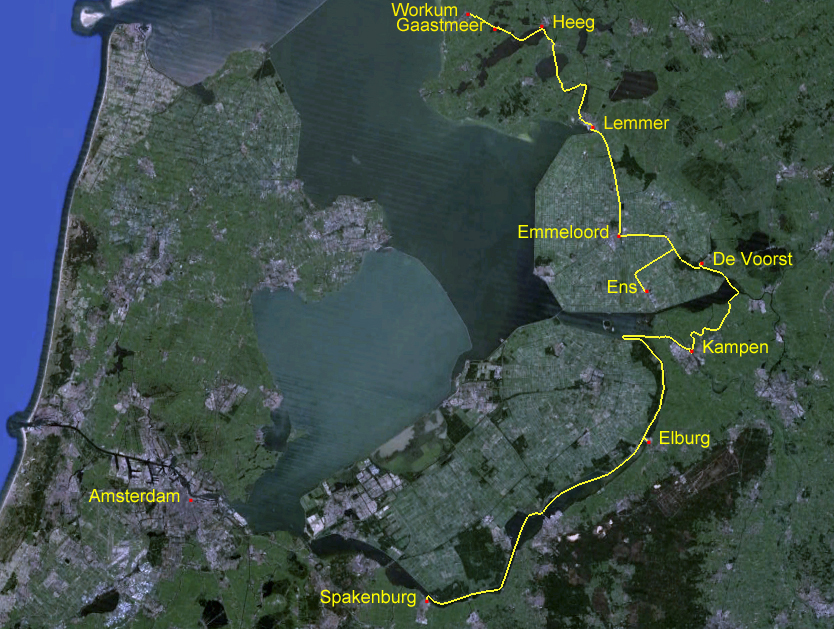
At 1000 on Saturday the 29th of June we slipped from the wharf in Ens and headed back out the blind Enservaart to the Lemstervaart and turned southward. Shortly after noon we arrived at Voorstersluis, which brought us back up out of the level of the Noordoostpolder. From De Voorst we followed the Kadoeler Meer southeastward to Zwarte Meer, which we crossed using the buoyed channels to the Scheepvaartgat, which led us in a strong cross wind to the Goot and along it to the Ganzen Diep.

Along the way we wound a very sinuous route through idyllic rural scenery.

Although Kampen is only 10 kilometres from Ens, the water route we had to follow linked together several canals and lakes and took us 36.3 kilometres. We arrived in Kampen at 1825 and secured to the melden pier in Jachthaven Seveningen to fill with water, and were told we could remain in place on the pier overnight.

The distance from Kampen to Elburg is thirteen kilometres overland; however, the shortest water route is 32.1 kilometres. The route follows the IJssel downstream to the Ketlemeer, where it goes around the end of a long dike and heads in the opposite direction up the beginning of the Randmeeren, the chain of lakes between the old Zuiderzee coast and the newly formed province of Flevoland. There were many huge commercial barges on the IJssel, but also a few smaller vessels.

As we headed around into Drontermeer there was a rather steady stream of pleasure craft coming and going, many of them under sail in the stiff breeze. The weather continued cold and bleak, with heavy mist alternating with rain showers throughout the day.

At 1305 we secured to the wharf in Elberg after a three-hour trip, the first part of which was aided by the current running in the IJssel. We cycled through the main gate of this medieval moated and walled city.

We admired the beautifully kept homes that abut the insides of the walls. The lanes are a profusion of flowers interspersed with patio furniture; the residents obviously enjoy their tiny front yards.

Lanes invited us to explore further into the old town.

A fifteenth century church stands solidly among stately houses of the same era and earlier. We spent two days relaxing and enjoying this wonderful place.

At 1035 on Tuesday the 2nd of July we slipped and headed out to continue our way around the Randmeeren. We followed the buoyed channel along Veluwemeer, passed through the open sluis at Hardewijk into Wolderwijd and followed its buoyed channel to Nuldernauw and then through Nijkerkersluis to Nijkerkernauw, which took us after a 42.6 kilometre day to Spakenburg. Not long after we secured to the wharf, a line of wooden botters paraded past.

There are about forty of these marvellously restored and maintained old fishing boats here in Spakenburg, many of of them dating from the late nineteenth century.

The botters were heading out for a regular evening sail on the Eemmeer.

After we had watched about thirty of them go past Zonder Zorg, we walked out to the end of the dike to get a better view of them sailing on the meer.

This is so dramatically different from an evening sail on Vancouver's English Bay that it seems we're on another planet. A few hours later, while we were having dinner aboard Zonder Zorg, the parade of botters came slowly past our salon windows.

In a light drizzle at 1400 on Wednesday we motored out of Spakenburg and continued around the Randmeeren. First we went northward along Eemmeeer and then northwestward along Gooimeer and finally north under the Hollandsebrug and into the southern end of Markermeer. It was raining rather persistently and the wind was gusting into Force 4 from the northwest, the direction we needed to go. We decided to seek shelter on the south side of a tiny uninhabited island, named Hooft.

At 1620 we tied to small trees on a dilapidated wharf in a space among half a dozen quasi-derelict boats and two considerably more proudly owned ones. We were secured out of the wind for the night. It continued to rain.

After a leisurely breakfast on Thursday morning, we slipped our lines and headed across Markermeer toward Buiten IJ and the entrance to Noordzee Kanaal. Marine traffic is nicely separated, with the central lanes for large commercial vessels and side lanes for smaller and recreational ones. The locks are also segregated, and we were the first to arrive and wait for the next cycling of the non-commercial side of Oranjesluizen.

We waited for about fifteen minutes as the lock tenders shepherded nine boats of various ages, shapes and sizes into the chamber. After all the juggling, we were lowered only about 20 centimetres.

We were then in the Noordzee Kanaal, which leads across Amsterdam and out into the North Sea. We motored with heavy traffic past central Amsterdam under clearing skies.

Westward, we were in the zone of the deep sea ships and passing the heads of many busy side harbours. Traffic became increasingly heavy and fast.

The wind built and we were butting into building chop. After about 30 kilometres we turned off the Noordzee Kanaal into Zijkanaal, which led us southwestward to Noorder Buiten Spaarne and onward into Haarlem.

At 1651 we secured to the wall of the canal in the heart of the old city of Haarlem, at the foot of the street up which 150 metres is the magnificent Sint Bavokerk, which has dominated the city skyline for at least six centuries. Beside us is Teylers Museum, the oldest museum in the Netherlands.

With Zonder Zorg in such a wonderful place, and with the weather finally looking a bit more summer-like, we have decided to pause here for a week and explore the area.